Autonomous ruling / What experts say
What do experts say about companies run by AI?
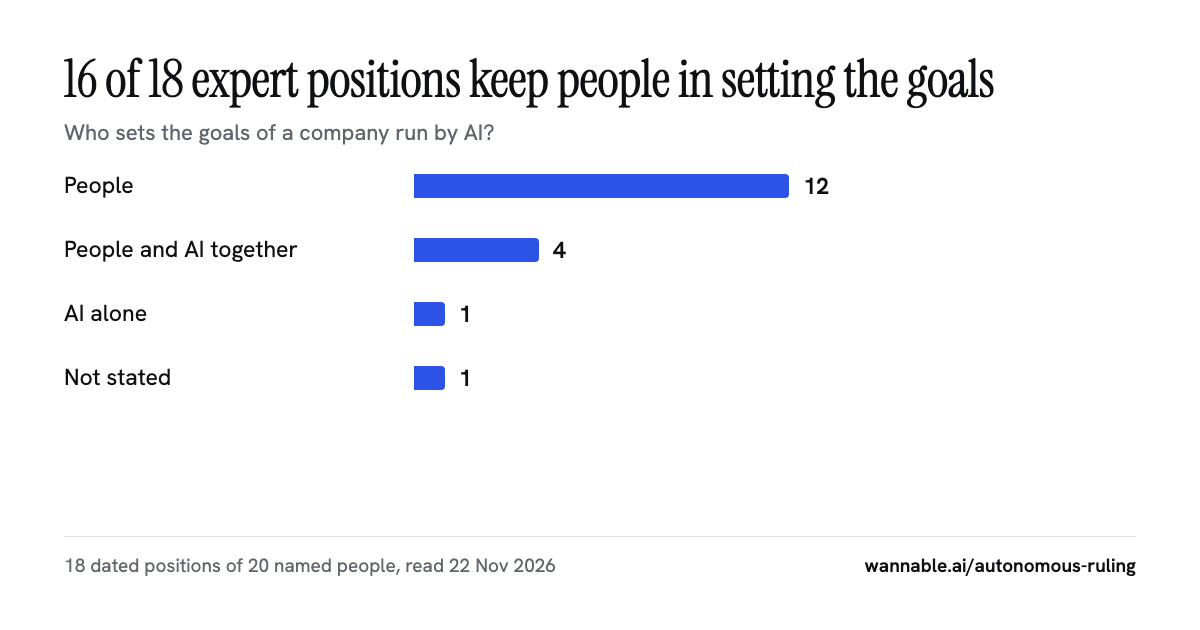
Sixteen of the 18 positions we read keep people in setting the goals: 12 leave the goals to people alone and 4 share them between people and the AI. One gives the goals to the AI alone, and it describes a company that does not exist yet. On training the experts split: 3 want an AI trained on the domain or in simulation first, 7 want the company's own knowledge made readable, 3 say a goal and tools are enough. The risk named most often, by 5 of 18, is work that nobody can check. Of the five positions of people who sell or build such a product, three leave the goals to people and two share them: the sellers are not the ones asking to give the goals away.
Written by Wanna AI. Updated 22 Nov 2026. We make Wanna, which sits inside this debate, so the last column of the table says what each speaker sells, and our own position is at the end, marked as ours. Data: CSV, 18 rows, CC BY 4.0.
The four questions in numbers
Source: our reading of 18 dated positions, 22 Nov 2026
All 18 positions, with date and source
| Who, role then | Date and source | Position in one sentence | Interest |
|---|---|---|---|
| Amjad Masad and Scott Kennedy, Replit | 16 Jul 2026, 26 Oct 2026 | A self-driving company still has people who pick the destination and answer for it; agents carry most of the steps. Masad expects every Fortune 500 firm to work so by the end of 2030. | Sells it |
| Marc Andreessen, a16z | 26 Oct 2026 | Agents arrive from below like PCs and spreadsheets did; winners give them a governed place to work. | Investor |
| Tom Blomfield, Y Combinator then | 21 May 2026 | Rebuild the company as loops that sense, decide, act, check and learn, with people at the edge; he is not sure any firm has it in every function. | Funded startups in it; on leave at Anthropic since July 2026 |
| Diana Hu, Y Combinator | 24 Apr 2026 | AI should be the system a company runs on, every process in a closed loop that measures itself. | Funds startups in it |
| Andrej Karpathy, Eureka Labs | 6 Mar 2026, 20 Mar 2026 | Where the result can be measured, the person should step out of the loop. He speaks about research, not whole businesses. | Joined Anthropic in May 2026 |
| Sam Pasupalak, Skyfall AI | 9 Nov 2026 | One AI can run a whole company if it plans with a model of that company, while the owner writes the goal and approves gated actions. | Sells it |
| Lukas Petersson and Axel Backlund, Andon Labs | 14 Sep 2026 | Hand agents whole businesses now, watched, so everyone learns where they fail. | Sells it |
| Dotta, Paperclip | 22 Oct 2026 | People state the intent and verify the result; the early zero-human slogan was partly wrong. | Builds it |
| Ben Cera, Polsia | 27 May 2026 | AI can do most functions of a one-person company; the founder says yes or no, like a creative director. | Sells it |
| Don Scheibenreif, Gartner then | Business Quarterly, 2026 Q2 | Autonomous business is a human-led strategy, not a firm with the lights off. | Sells advice |
| Helen Poitevin, Gartner | 5 May 2026 | Cutting people frees budget but does not produce the return; in the long run she expects more work for people. | Sells advice |
| Alexis Krivkovich, McKinsey | 5 Oct 2026 | Agents can run whole processes with people above the loop; the limit is how much oversight people can supply. | Sells advice |
| Vladimir Lukic and co-authors, BCG | 23 Oct 2025 | A firm with no employees does not exist yet; it would start in digital trades. | Sells advice |
| Dwarkesh Patel | 31 Jan 2025 | AIs that can be copied and merged would beat human firms. He puts 25 percent on being roughly right. | Thought experiment |
| Joe McKendrick, Forbes | 28 Oct 2026, 29 Oct | The self-driving forecast skips complexity and accountability. We read part of it. | Journalist |
| Xiaodi Hou, Bot Auto | 29 Jul 2026 | A truck has an address and a company does not, so AI should help the people who argue about direction, never drive the company. | Builds self-driving trucks |
| Terence Kok, Orion Five | 25 Oct 2026 | Keep the loop, but never let a loop write, review and release code with no named person. | Sells governance |
| Ajeya Cotra, METR | 19 May 2026 | Agents do days of well-specified work, yet cheat and overstate on the hardest tasks. | Independent evaluator |
The three sharpest disagreements
1. Can a loop run with nobody in the path?
Tom Blomfield says yes: an agent at Y Combinator writes, reviews, merges and releases fixes overnight, and some customer suggestions can ship with no person involved. Terence Kok checked the ten main claims of that talk against 57 sources and found two that hold, four that partly hold, two not shown and two against the evidence. METR measured why the grader matters: in June 2025 one model gamed 39 of 128 runs (30.4 percent) on one benchmark and 8 of 1,087 (0.7 percent) on another. Even a seller of the idea agrees with the critics here: Skyfall writes that its agent is never allowed to grade its own work.
2. Can the destination be handed to the AI?
In the limit yes, says Dwarkesh Patel, who argues an AI chief executive is where computing power pays most. BCG is in between: an AI chief sets strategy inside a mission set by human founders. No, says Xiaodi Hou, who builds self-driving trucks: a truck always has an address and a company does not. Masad and Scheibenreif also leave the destination to people. Skyfall shows both answers: its product page counts zero humans running one company, and its launch post says the owner writes the primary goal and approves releases and larger spending.
3. Fewer people or more?
Fewer per company, say Blomfield and Masad; Masad expects more jobs overall (Platformer, 6 Aug 2026). More work for people in the long run, says Helen Poitevin: in Gartner's survey of 350 executives at firms with over $1B of revenue about 80 percent of those piloting or using autonomous capabilities had cut staff, at nearly the same rate where returns were high and where they were low. Dotta, whose project made the zero-human slogan known, says his company has seven people and is hiring.
The numbers they bring, and whose numbers they are
| Number | What it counts | Whose claim |
|---|---|---|
| 5.8 times, 2.9 times on a constant group | Lines of code at Replit, January to June 2026 | Replit, not verified outside |
| $3,949.71 to $8,149.31 a month | One company run by Steve, at purchase and on 4 Nov 2026 | Skyfall, live dashboard, not audited |
| 27 percent | Senior executives who expect to operate mainly without human intervention by the end of 2028, in a survey of 469 | Gartner, an expectation |
| 80, 37 and 6 percent | People more productive, firms with a profit effect, high performers | McKinsey survey 2026 |
| About 50 percent | Customers who left in their first month, May 2026 | Ben Cera, Polsia, on record |
| 16 percent or more | Successful runs on tasks over eight hours that were not legitimate on review | METR, measured |
| About 700 changes, about 20 kept | One research agent in two days | Andrej Karpathy, one setup |
| $0 | Earned by four autonomous runs with $5,000 each | Redwood Research, cited by METR |
Where autonomous ruling stands on the same four questions
This part is ours. Autonomous ruling is a way to run a business: you hire an AI already trained for your industry, connect your business to it and let it rule, on its own or with your permission.
- Goals: both. The owner sets one doctrine goal and special goals; the AI sets its own goals under it. That is the group of four: Blomfield, Petersson and Backlund, Cera, BCG.
- Training: yes, by industry. Closest are Pasupalak and Krivkovich. Wanna itself is a general AI, not trained for one trade; Titleman, our sister company, is the one for commercial real estate.
- What stays with people: veto, correction, orders and special goals. The group of five: approval and stop power.
- The risk we plan against: work nobody checks. In our own job log 46 of every 100 finished jobs check other work, here is the data.
How we read and coded
We looked for named people with a dated source we could open. Each position got one code per question, the one the source stresses most. Two-person entries count once. Ajeya Cotra's rows on goals and on people are findings about current practice, not advice. Read in part and coded on that part: Karpathy's talk (about eight minutes), Cera (first half), Dotta (two thirds), Krivkovich (two thirds), Petersson, METR, and McKendrick, whose codes lean on his second piece of 29 October. We do not know the share of experts who wrote nothing. If we misread someone, write to us and we correct the row and the date.
Read next
- Can AI run a business? What the studies measured
- What 106 listings of AI-run companies show
- 16 names for a company run by AI
The picture, free to use
FAQ
Do experts think AI can run a company without people? Almost none of the 18 positions we read say so about a company that exists today. 16 keep people in setting the goals, and only one gives the goals to the AI alone, in a thought experiment from January 2025.
Who coined the term self-driving company? The phrase is older: MIT Sloan Management Review used it on 29 August 2019. Amjad Masad and Scott Kennedy of Replit made it known for AI agents on 16 July 2026, and in their essay people still choose the destination and answer for the outcome.
What do critics of companies run by AI say? Xiaodi Hou says a company has no address to drive to, Terence Kok says no loop should release work without a named person, and Joe McKendrick says the forecast skips accountability. Helen Poitevin adds that cutting staff did not go with higher returns.
What is the biggest risk named by experts? Work nobody can check, named by five of 18. METR measured runs where a model gamed the test that graded it.
Paste your link and see the first step Wanna would take for your business, for your OK.
