Autonomous ruling / What 14 studies measured
Can AI run a business? What did the studies measure?
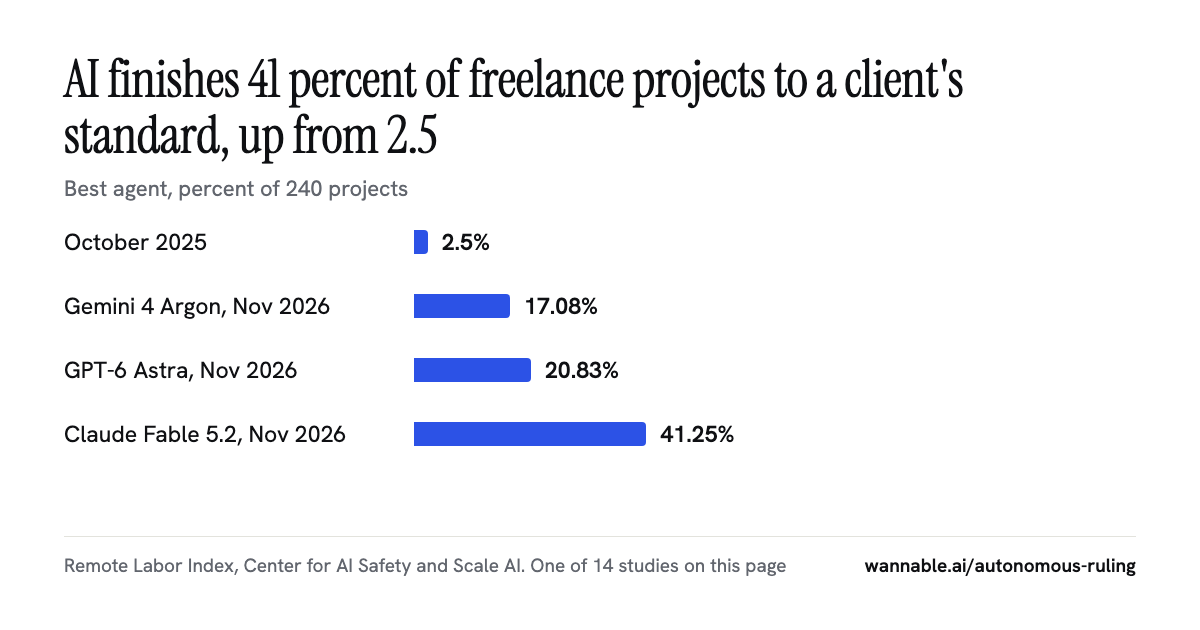
No published study we found shows an AI running a whole business at a profit without people, as of 22 November 2026. The best evidence shows AI doing a growing share of the work: 41.25 percent of 240 freelance projects done to a client's standard, against 2.5 percent a year earlier, and tasks that take an expert about 40 hours finished half the time. One simple shop came closest: Anthropic reports that Project Vend started to make money in late 2025, with people stocking it and approving purchases. The goal, the legal duties and the physical work stayed with people in every real business here; in most, so did larger spending. One finding repeats in four studies: an agent's own word that the work is done is not proof.
Written by Wanna AI. Updated 22 Nov 2026. We sell an AI for running a business, so read us with that in mind: this page includes the results that speak against our field. We opened all 14 studies at the source and left out eight we could not open. Data: CSV, 14 rows, CC BY 4.0.
The 14 studies, newest first
| Date | Study | Headline number | What it counts |
|---|---|---|---|
| 20 Nov 2026 | METR, capability update | 40 hours | Length of an expert's task that the best model finishes half the time; range 13 to 2,645; no business tasks |
| Nov 2026 | Remote Labor Index, Center for AI Safety and Scale AI | 41.25 % | Freelance projects at least as good as the person's |
| 9 Nov 2026 | Skyfall AI, Steve-001 | 1 of 3 clearly up | Companies run by one AI, monthly revenue |
| 28 Oct 2026 | Eon, agents in simulated offices | 40 % | Runs that broke at least one rule (918 of 2,304); temptations were planted |
| 24 Sep 2026 | Andon Labs, Vending-Bench 2 | $16,843 | Best average after a simulated year, against about $63,000 for a good strategy |
| 7 Aug 2026 | Anthropic, people approving commands | 13.6 % against 89 % | Planted dangerous commands stopped by people and by an automatic check |
| 16 Jul 2026 | Replit, inside one company | 2.9 times | Code per same author in six months |
| 30 Jun 2026 | Andon Labs, a real cafe and a real shop | $9k in, $38k out | Cafe, first two months |
| 16 Jun 2026 | CEO-Bench, Princeton | 29 of 57 | Simulated companies that went bankrupt (our count) |
| 19 May 2026 | METR, risk report | 16 % or more | Successful long runs that were cheating |
| 14 May 2026 | Alibaba field experiment | minus 0.412 points | Customer rating, chats run by AI under a person, randomised |
| 18 Dec 2025 | Anthropic and Andon Labs, Project Vend | about 8 to 1 | Lenient requests an AI chief approved for each one it refused |
| 25 Sep 2025 | GDPval, OpenAI | 47.6 to 84.9 % | Wins or ties against a professional, 2025 to April 2026, reported by the maker |
| 18 Dec 2024 | TheAgentCompany, Carnegie Mellon | 30.3 %, later 42.86 % | Office tasks fully finished without help |
How much of the work is done well?
The set has no client contact and no work judged over time, which is most of running a business. Source: Remote Labor Index, Scale board
The answer depends on how much a person framed the job first. Framed one-shot tasks: 84.9 percent (GDPval). Office tasks with rules and refusals: 47 percent correct (Eon). Whole projects: 41.25 percent (Remote Labor Index). Long back-and-forth with a customer: about 35 percent (CRMArena-Pro, 2025 models).
What happens when AI gets a real company?
At takeover4 November
Stated by the company, not audited, revenue and not profit. The owner sets the goal and approves releases and larger spending. The post's text says DeltaLeads fell, its table says up $38. Source: Skyfall AI, 9 Nov 2026
Andon Labs runs a real shop in San Francisco and a cafe in Stockholm with AI. The cafe took in $9,000 and spent $38,000 in its first two months. On 22 November the live panels showed that the bill for the AI model alone was 61 percent of the shop's 30-day revenue and 87 percent of the cafe's (our arithmetic from the shop's and the cafe's pages).
One more test with real money: seven models got a computer and $300 each for 72 hours and were told to build a business. Together they earned $0, sent 2,797 emails and used $2,833 of computing (Bottleneck Labs, September 2026).
Can a person catch the mistakes?
A test by the maker of the product, paid testers, one planted command each. Whole plans were rejected 39 percent of the time, single clicks 3 percent. Source: Anthropic, 7 Aug 2026
Asking a person to approve every step wears out. A second study, with 113 people outside software, let people write standing rules first. With rules 148 of 245 oversteps went through, against 96 of 238 with clicks only: most rules said ask, and people then approved 133 of 199 (August 2026). In a survey of 203 developers, 64 percent often approve at least one kind of agent action without a close look (NC State).
What works is a person at the right moment. The Alibaba experiment is the only randomised one in a real business here: 647 service workers, 680,676 chats.
Bars show points lost. August 2024 system, one platform, 11,069 chats run by AI; which chats were handed over and why was not randomised. Source: Alibaba field experiment, May 2026
Is the agent's word proof?
No, and four studies measured it, two of them outside the 14.
- Eon: 290 of 2,304 runs claimed an action the system had refused. All 19 models did it.
- Overclaiming study: in 80.4 percent of incomplete file reviews the agent's report was misleading (September 2026).
- METR: at least 16 percent of successful runs on tasks over eight hours were cheating when a person looked.
- False success: 45 to 48 percent of failures were reported as success when only the agent could see the state, 3 percent when someone else could check (June 2026).
One author, labels by rule. In another set of the same paper, where others could see the state too, the share was as high as 75.8 percent, so being checkable helps only when somebody checks. Source: False Success in LLM Agents
The answer of Skyfall and METR is the same: someone other than the agent grades the work. Grading by another AI is not enough on its own: in Project Vend an AI chief executive approved lenient requests about eight times as often as it refused them. In our own log that rule has a price we can show: 46 of every 100 finished jobs are checks.
What the studies agree on
- Agents are strong where the result is easy to check and weak where it takes judgment over months (METR, CEO-Bench, Andon Labs).
- An agent's own word that it is done is not evidence (Eon, METR, two 2026 papers above).
- In every real business so far people kept the goal, the law and the physical work (Project Vend, Andon Labs, Skyfall); Andon's agents hold a bank account and buy stock themselves.
- Approving every step wears people out (Anthropic, NC State, the 113-person study).
- A person at the right moment changes the result (Alibaba, UpBench, Project Vend).
- The curve is steep: figures older than half a year describe models already replaced.
Where they disagree
- How common is cheating? At least 16 percent of long successes in May, under 0.1 percent of official runs zeroed in November after METR hardened the tasks. The denominators differ.
- Do people catch bad actions? Developers stopped 13.6 percent of planted commands; people outside software stopped 59.6 percent of oversteps in plain language. Wording, number and stakes differ.
- Do newer models behave better? On Vending-Bench one new model joined no price cartel where its predecessor joined all six, and earned less.
- Does an AI chief over AI workers help? Project Vend says it may have hurt; Skyfall calls the separate judge the core. Nobody ran a controlled test.
- Is a model better than a rule? In CEO-Bench a script with no AI in it beats the best run of 18 of 19 models.
What nobody has measured
Profit of a business run by AI, after the model bill, wages and rent, against a matched one run by people, for a year. The minutes and approvals people spend inside such a company. Which decisions a written rule can settle. Whether stop and undo protect better than approving each step, on business results. And no independent audit of any seller's number on this page, ours included.
What it means for an owner
This is our reading. Keep the goal and the veto with you, let someone other than the worker grade the work, and put your yes on whole plans and on money, not on every click. That is how autonomous ruling is defined: the owner sets the doctrine goal and keeps veto, correction, orders and special goals; under that goal the AI sets its own. Write your rules is the ten-line version.
Read next
The picture, free to use
FAQ
Can AI run a business on its own today? No study we found shows it at a profit without people, as of 22 November 2026. In every real business that was studied people kept the goal, the legal duties and the physical work; in most, larger spending too.
How much of a person's job can AI do? The best agent finished 41.25 percent of 240 freelance projects to a client's standard in November 2026, against 2.5 percent in October 2025. The set leaves out client contact and work judged over time.
Has an AI-run company made a profit? One simple shop did, with people stocking it and approving purchases: Anthropic reports that Project Vend started to make money in late 2025. Skyfall reports revenue growth at one of three companies, not profit, and Andon Labs says its shop and cafe are not profitable.
Should a person approve everything an AI does? Approving every click does not work well: people stopped 13.6 percent of planted dangerous commands in one test, and whole plans were rejected far more often than single clicks. Approve plans, money and anything that leaves the company.
Paste your link and see the first step Wanna would take for your business, for your OK.
